RudraM-II passes crucial test as India sharpens indigenous strike capability
The successful RudraM-II trials validated multiple critical systems and highlighted collaboration between DRDO laboratories, the Indian Air Force and industry partners.
At a Sindhi community event in Delhi, Rajnath Singh recalled LK Advani’s writings on Sindh’s cultural links with India, saying borders can change. He also defended the CAA as a measure to support persecuted minorities from neighbouring countries.




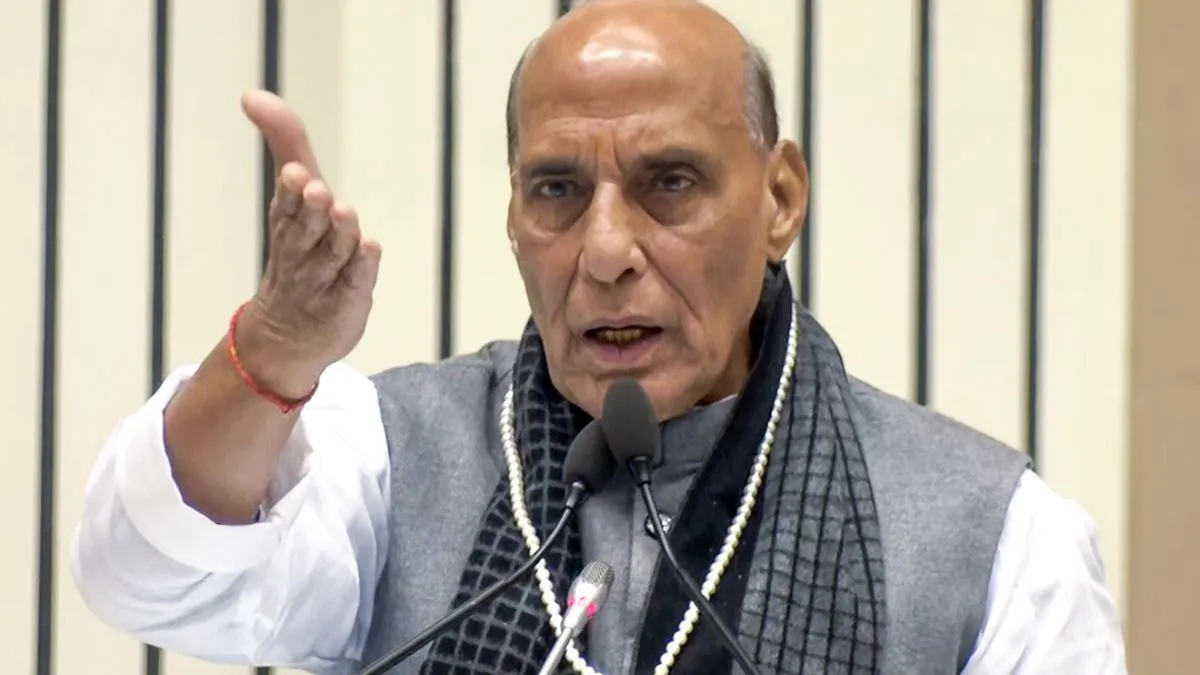
Defence Minister Rajnath Singh on Sunday invoked former deputy prime minister Lal Krishna Advani’s reflections on Sindh’s cultural and spiritual ties with India, saying that while the region may lie across the border today, its civilisational link remains intact. Addressing an event organised by the Sindhi community in New Delhi, Singh referred to Advani’s quote and added that “tomorrow, Sindh may return to India”.
He recalled that veteran BJP leader Advani, born in Karachi on November 8, 1927, before Partition, had written about how many Sindhi Hindus of his generation never reconciled with Sindh’s separation from India in 1947.
Advertisement
“Advani ji wrote in one of his books that Sindhi Hindus, especially those of his generation, still haven’t accepted the matter of separation of Sindh from India,” Singh said at Sindhi Samaj Sammelan.
Advertisement
Quoting Advani further, the minister said: “Not just in Sindh, but throughout India, Hindus considered the Indus River (Sindhu in Hindi) sacred. Many Muslims in Sindh also believed that the water of the Indus was no less sacred than the Aab-e-Zamzam of Mecca.”
“This is Advani ji’s quote,” Singh noted, emphasising that the cultural bond predates modern political boundaries.
Singh said that while the entire Sindh province now lies in Pakistan, “civilisationally, Sindh will always be a part of India”.
The Defence Minister, while referring to a quote of Advani, added: “And as far as land is concerned, borders can change. Who knows, tomorrow Sindh may return to India. Our people of Sindh, who hold the Indus River sacred, will always be our own; no matter where they are, they will always be ours.”
#WATCH | Delhi: Defence Minister Rajnath Singh says, “…Today, the land of Sindh may not be a part of India, but civilisationally, Sindh will always be a part of India. And as far as land is concerned, borders can change. Who knows, tomorrow Sindh may return to India again…”… pic.x.com/9Wp1zorTMt
— ANI (@ANI) November 23, 2025
The minister did not specify which of Advani’s books he was drawing from.
Advani had earlier remarked, during a 2017 event in Delhi, that “India appears incomplete without Sindh,” expressing sadness that his birthplace was no longer part of India.
Meanwhile, Singh also spoke about how the Partition altered the geography of the Indus River, with a significant stretch flowing into Pakistan after 1947. But, he stressed, this shift had not diminished the cultural value of “Sindhu, Sindh and Sindhi”.
He added that the region’s imprint continues in national consciousness, noting its mention in the national anthem — “Punjab, Sindh, Gujarat, Maratha” — and said this association would remain “for as long as we exist”.
In his address, Rajnath Singh also spoke at length about the Citizenship Amendment Act (CAA), describing it as a measure intended to support minority communities from neighbouring countries who faced severe violence and discrimination.
He said that several families who fled to India after enduring attacks, forced conversions and the loss of loved ones were treated unfairly by previous governments.
“…Minority communities in many neighbouring countries have been suffering for years. Their homes were burned, their children were killed, their daughters were subjected to cruelty and torture, and people were forcibly converted,” Singh said.
“When many of them somehow managed to escape and come to India, the treatment meted out to them by appeasement-seeking governments cannot be condemned enough. They were humiliated simply to appease the vote bank of a particular community.”
Singh argued that while a “special class” of migrants received refuge earlier, Hindu communities facing persecution were overlooked.
“A special class of people coming from neighbouring countries was given refuge. But the people of this Hindu community, who truly deserved it, were not given the rights they deserved. Their suffering was not understood with compassion,” he said.
“But if anyone understood this pain, it was our Prime Minister Narendra Modi… That is why we introduced the Citizenship Amendment Bill.”
The Citizenship (Amendment) Act, 2019, provides a pathway to Indian citizenship for migrants belonging to Hindu, Sikh, Buddhist, Jain, Parsi and Christian communities from Pakistan, Bangladesh and Afghanistan, who entered India on or before December 31, 2014.
The Act was notified on December 12, 2019, and came into force on January 10, 2020.
Advertisement